Physical Address
304 North Cardinal St.
Dorchester Center, MA 02124
Physical Address
304 North Cardinal St.
Dorchester Center, MA 02124

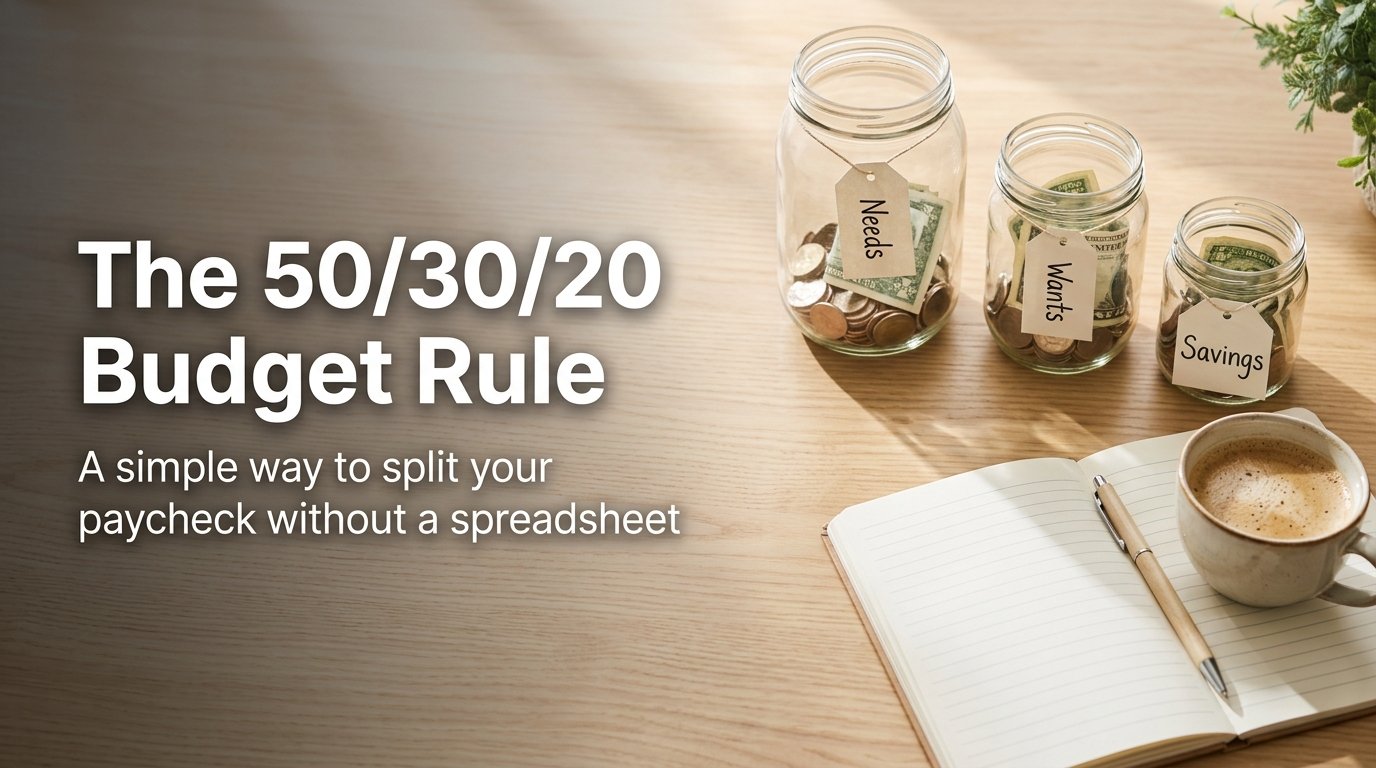
Learn how the 50/30/20 budget rule works, see real examples, and find out how to adjust it when your needs cost more than half of your income.
If you have ever searched for a simple way to budget, you have probably run into three numbers: 50, 30, and 20. They show up in articles, videos, and banking apps, usually presented as a magic formula. I was curious about that. Is it really that easy? And what happens when your own numbers refuse to fit?
After reading about where the rule came from, looking at how the average American household actually spends money, and studying the stories of people who tried it, my honest answer is this: the 50/30/20 rule is a very good starting point, and a poor set of handcuffs. It gives you a quick way to see whether your spending is balanced. But it was never meant to be a law, and for many households it needs adjustments.
In this guide I’ll explain exactly how the rule works, walk through a full example, show you where the gray areas are, and share three real accounts from people who put it to the test. I’ll also show you what to do when your essentials cost more than half of your paycheck, because that is the situation a lot of beginners are in.
A quick note before we begin. I’m not a financial advisor, and this article is educational only. If you are struggling to cover basic bills or you are dealing with heavy debt, please speak with a qualified professional. I’ll point out when that makes sense.
If you are brand new to budgeting, I suggest reading my guide on how to make your first budget from scratch first. It explains how to find your real numbers, which you’ll need for this method. And if you want the bigger picture of why any of this matters, my article on what financial freedom really means is a good companion.

The 50/30/20 rule is a budgeting method that splits your after-tax income (your take-home pay) into three buckets:
That is the whole rule. You do not need a dozen categories or a complicated spreadsheet. You only need to know your take-home pay and sort your spending into three groups.
Many money websites describe the method in almost exactly these terms, and they trace it to the 2005 book All Your Worth: The Ultimate Lifetime Money Plan, written by Elizabeth Warren, who was then a Harvard Law professor, and her daughter, Amelia Warren Tyagi. Some writers point out that Warren and Tyagi did not invent the idea of budgeting in percentages. What they did was package it into an easy-to-remember format that spread widely.
I mention the origin for one reason: it helps to remember that this is a rule of thumb from a general-audience book, not a scientific law or a government standard. Please treat it that way.
There are a few reasons this method has lasted for so many years.
It is simple. Three buckets are easy to remember. When you are overwhelmed by money, simplicity matters.
It builds saving into the plan. Many budgets only track spending. The 50/30/20 rule makes saving and debt payoff a built-in category, not an afterthought.
It allows for fun. Thirty percent for wants is a lot. The rule explicitly says that enjoying your life is part of the plan, which makes it easier to stick with.
It is a quick check. Even if you do not follow it strictly, comparing your actual spending to the three percentages can show you at a glance where you are out of balance.

Needs are expenses you cannot easily skip without serious consequences. Typical examples include:
Wants are the things that improve your life but are not required. Examples:
This bucket is for money that makes your future more secure:
Notice that minimum debt payments sit in the needs bucket, while anything extra goes into the 20 percent. Different websites handle this slightly differently, so what matters most is that you pick a way to sort and stay consistent.
Let’s use round numbers. Imagine someone with a monthly take-home pay of $3,000. This is an illustrative example, not a real person and not a recommendation.
| Bucket | Percentage | Monthly amount |
|---|---|---|
| Needs | 50% | $1,500 |
| Wants | 30% | $900 |
| Savings and debt payoff | 20% | $600 |
So the target is to keep needs at or under $1,500, wants at or under $900, and to put at least $600 toward the future. To apply it, you simply multiply your take-home pay by 0.5, 0.3, and 0.2.
Now here is where reality usually enters. When this person tracks their spending for a month, they might find:
Their needs are 65 percent of their income, not 50. Their wants are only 15 percent. Their savings are right at 20 percent. This is a very common pattern, and I want you to see that it is not a failure. It is information. It tells this person that their cost of living is the big pressure, not their fun spending.
The hardest part of the 50/30/20 rule is deciding what is truly a need. Here are the questions that come up most often.
Is my cell phone a need? Basic phone service usually is. A premium plan and the latest device are partly a want.
Is my car a need? If you need it to get to work, then yes, within reason. But the difference between a reliable used car and an expensive new one is where a need turns into a want.
What about groceries versus restaurants? Groceries are a need. Restaurants and delivery are wants. This is one of the most common places where beginners discover a surprise.
What about my gym membership or streaming services? Usually wants. Some people consider exercise a health need. Be honest with yourself.
What about debt payments? The minimum is a need, because missing it has consequences. Extra payments go in the savings and debt bucket.
My advice is to pick a rule, write it down, and use it consistently. The percentages matter less than the habit of checking.

Rules are easy to describe and harder to live. Here are three real accounts from published articles. I’m only including what these people said, and the original articles are in the references.
A recent article distributed by AOL describes a mortgage expert named Cody Schuiteboer who tested the 50/30/20 method for 30 days to see whether the advice he gives clients actually works. What surprised him most was not that he needed to cut spending. It was that many items he had put in his “needs” column turned out to be unnecessary expenses he had stopped noticing.
He also said that documenting his spending helped him spend less almost automatically, without relying on discipline or deprivation.
My takeaway: the act of sorting expenses into needs and wants can reveal costs you have normalized. The method works partly because it forces you to look.
In the same article, family finance advocate Emily Collins, who runs Money for the Mamas, said the framework gave her a kind of permission to spend on wants. But she also pointed out that the needs category gets complicated for families. According to her, childcare alone can take 20 to 30 percent of take-home pay in many markets. Add a mortgage, insurance, and groceries for a family of six, and she says you are living in a 65 to 70 percent needs reality before buying a single want.
My takeaway: the 50 percent cap does not account for family size. If you have kids, your numbers may look very different from a single person’s, and that is normal.
Not everyone loves the rule. In a Business Insider essay, author Jackie Lam wrote that she tried the 50/30/20 budget but found it time-consuming and stressful. She described worrying about whether a single bill, like a car insurance premium, would tip her needs category over its limit, and feeling nervous when holiday spending or sales pushed her wants above 30 percent. She created her own “money flow” system instead, and said that approach helped her save more than $20,000 and build her emergency fund.
My takeaway: a method is only useful if you can keep using it. If strict categories make you anxious, a looser approach may serve you better. The goal is saving and control, not perfect percentages.
Taken together, I notice three things. First, sorting your spending is valuable even if the percentages are not exact. Second, family size and housing costs can push the needs bucket well above 50 percent. And third, you are allowed to change methods. These are accounts that people chose to share, so they reflect individual experiences and not a guarantee of results.
Here is how I would apply it, step by step.
Use what lands in your account after taxes and payroll deductions. If your income changes from month to month, use a conservative number, such as your lowest recent month. My guide to making your first budget explains how to do this.
Multiply your take-home pay by 0.5, 0.3, and 0.2. Write down the three amounts. These are your targets, not your rules.
Look at your bank and card statements for the past month, or track your spending for the next 30 days. As I mentioned in my budgeting guide, tracking for at least a month matters because it captures bills and irregular costs you might otherwise forget.
Go line by line and assign each expense to needs, wants, or savings and debt. When you are unsure, ask: “What happens if I stop paying this tomorrow?” If the answer is a serious problem, such as losing housing, transportation to work, or utilities, it is probably a need.
Add up each bucket and divide by your take-home pay to get percentages. Compare them with 50, 30, and 20. There is no judgment here. You are simply looking at the gaps.
Pick the one or two changes that matter most. If wants are high, you may trim a few categories. If needs are high, see the next section. If savings are low, try setting up an automatic transfer on payday, even a small one, so saving happens before spending.

This is the most important section of this guide, because it describes what many beginners will find.
First, let’s look at the data. The U.S. Bureau of Labor Statistics reported that in 2024, the average household spent $78,535, and that housing alone took about 33.4 percent of that spending, with transportation at about 17.0 percent. Together, housing and transportation accounted for about half of household spending. That is an average across all kinds of households, including those with higher incomes, but it shows how heavy these two categories are before you add food, insurance, utilities, and everything else.
So if your needs come in at 60 or 65 percent, you are not necessarily doing something wrong. You may live in an expensive area, support children, or be earning an income that has not kept pace with prices.
Here is what I would consider, in this order.
1. Look at the biggest numbers first. Cutting three small subscriptions will not fix a budget where rent is the main issue. Housing, transportation, and childcare are usually the levers that matter most. That said, big changes like moving or selling a car deserve careful thought, and a professional can help if the stakes are high.
2. Protect the savings bucket. If you must flex the percentages, many people try to keep the 20 percent for savings and debt and shrink wants instead. For example, someone at 65 percent needs might aim for 65/15/20. You can also choose a temporary plan like 65/25/10 and rebuild toward 20 percent when things improve. The important part is to keep saving something, even if it is small.
3. Raise your income if you can. Sometimes the answer is not cutting but earning more. A raise, a better-paying job, or extra work can change the equation more than years of small cuts.
4. Revisit the plan every few months. Needs change with seasons, rent increases, and family changes. Treat your targets as living numbers.
5. Get help if needs exceed your income. If your essentials cost more than you earn even after careful cuts, that is a sign to talk with a nonprofit credit counselor or another qualified professional.
Freelancers, gig workers, and people with variable hours can still use the rule. Base your percentages on a conservative estimate, such as the lowest month in the last several months. In good months, put the extra into savings. In slow months, you’ll have a buffer. Some people also pay themselves a steady “salary” from a separate account to make their income feel predictable.
Car repairs, annual fees, gifts, and holiday spending do not appear every month, but they still need a home in your plan. One approach is to include a small monthly amount in the savings bucket for these predictable-but-irregular costs. This is sometimes called a sinking fund, and I’ll cover it in a separate guide. Without it, a single repair can push your needs or wants far over target and feel like a failure when it is really just poor timing.
The 50/30/20 rule is one of several options.
Many people combine methods. For instance, you might use 50/30/20 as a quick check and a detailed budget for the months when things feel tight. Whichever you choose, the best method is the one you will still be using three months from now.
Using gross income instead of take-home pay. The rule is based on after-tax income. Using your salary before taxes will inflate every bucket.
Calling everything a need. It is easy to label a want as a need. Be honest, and check your list again after a month.
Treating the percentages as a pass/fail test. As Jackie Lam’s experience shows, strict categories can create stress. Treat them as guidelines.
Forgetting irregular costs. A small monthly amount for car repairs and gifts prevents surprises.
Skipping the review. A quick monthly check keeps the plan alive. Without it, the percentages drift.
Ignoring your own situation. A family with childcare costs and a single person in a shared apartment have different realities. Adjust accordingly.
The 50/30/20 rule is a helpful tool, but it cannot solve every situation. Please consider speaking with a qualified professional, such as a nonprofit credit counselor, a certified financial planner, or a tax professional, if:
Before you hire anyone, check their credentials, ask how they are paid, and be cautious of anyone who promises guaranteed results or pressures you to decide quickly.
What is the 50/30/20 rule in simple terms? It is a budgeting guideline that splits your after-tax income into 50 percent for needs, 30 percent for wants, and 20 percent for savings and extra debt payments.
Does the 50/30/20 rule use gross or net income? It uses net income, which is your take-home pay after taxes and deductions.
What if my needs are more than 50 percent? That is common. Look first at your largest expenses, try to protect at least some savings, consider ways to raise income, and adjust the percentages to fit your reality. If your needs exceed your income, speak with a qualified professional.
Is the 50/30/20 rule good for beginners? Yes, as a simple starting point. It helps you see your spending in three groups and builds in savings. Just remember it is a guideline and not a rule you must follow exactly.
Where do minimum debt payments go? Minimum payments are usually counted as needs. Extra payments beyond the minimum belong in the savings and debt bucket.
The 50/30/20 rule will not fix your finances by itself. What it does is give you a simple lens: how much of my money goes to what I must pay, to what I enjoy, and to my future? Looking at your life through that lens is useful even if your numbers do not match 50, 30, and 20.
If you remember only one thing, let it be this: your percentages are information, not a grade. Track one month of spending, sort it into three buckets, and see what the numbers tell you. If your needs are high, focus on the biggest costs and protect some savings. If the rule makes you anxious, try a looser method. And whenever your situation feels bigger than a budget, bring in a qualified professional.
Disclaimer: This article is for educational purposes only and is not financial, legal, or tax advice. The examples are hypothetical, and results described in real stories do not guarantee similar outcomes. Please consult a qualified professional before making major financial decisions.