Physical Address
304 North Cardinal St.
Dorchester Center, MA 02124
Physical Address
304 North Cardinal St.
Dorchester Center, MA 02124

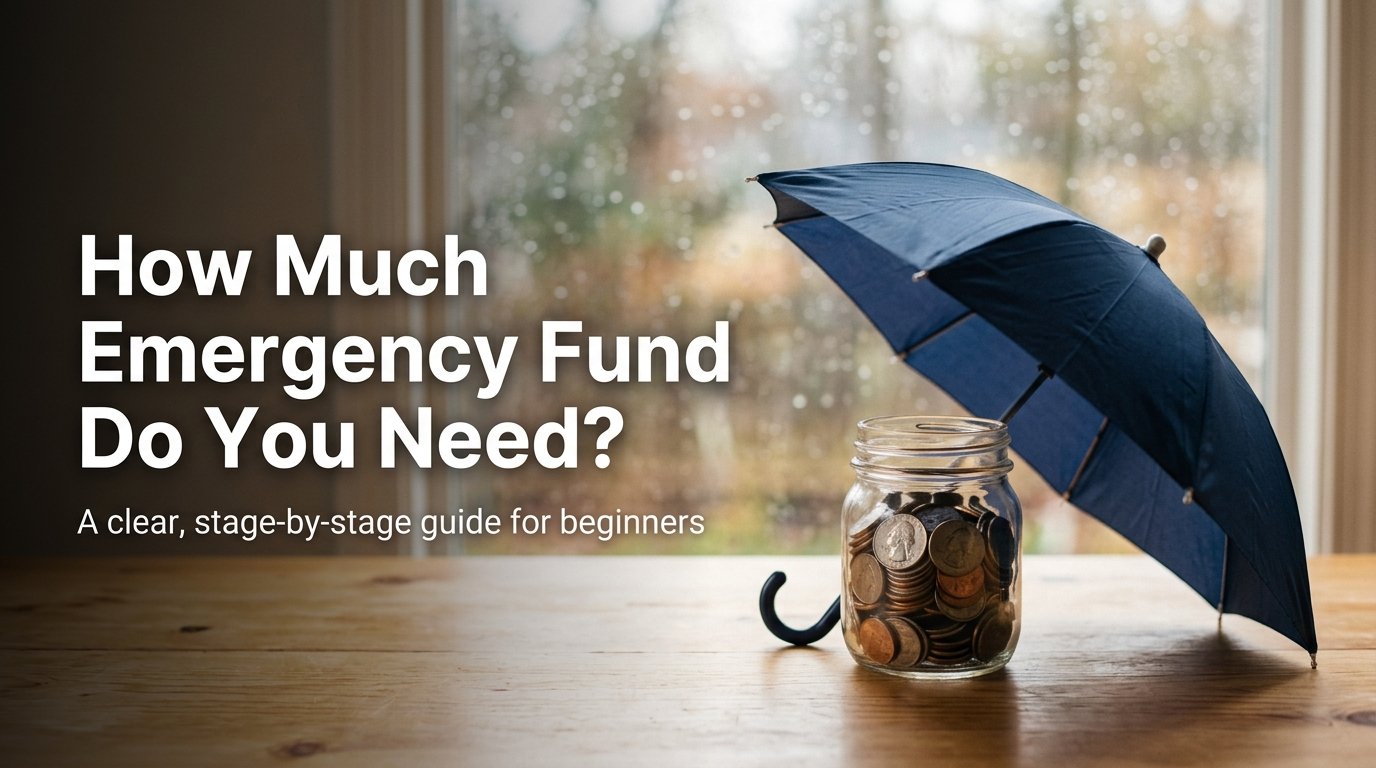
How much should you have in an emergency fund? Learn the starter goal, the 3 to 6 month rule, where to keep it, and real stories from people who used one.
If you have ever searched for how much to keep in an emergency fund, you have probably seen the same answer repeated everywhere: three to six months of expenses. That number is a useful guideline. But when I first read it, my honest reaction was a mix of confusion and discouragement. Three to six months of everything I spend? That sounded like a goal for someone else.
After looking at what official sources actually recommend, and at how real people used their emergency savings, I came to a more practical view. There is not one number. There are stages. A first goal of a few hundred dollars is meaningful. A goal of one month of essentials is better. And three to six months, or more, is a strong cushion that you build over time, depending on your life.
In this guide I’ll explain what an emergency fund is, how much to aim for at each stage, where to keep it, what counts as an emergency, and how to build it even when money is tight. I’ll also share two real accounts of people who relied on theirs, with honest limits on what we can learn from them.
A quick note before we start. I’m not a financial advisor, and this article is educational only. If you are dealing with heavy debt or a complicated situation, please talk with a qualified professional. I’ll tell you where that makes sense.
If you are just beginning, you may find it helpful to read my guide on what financial freedom really means. An emergency fund is a core part of the second step on that staircase: the capacity to absorb a shock.

An emergency fund is money you set aside, separate from your everyday spending, to cover unexpected and necessary costs. Think of it as a private safety net that you build for yourself.
The Consumer Financial Protection Bureau (CFPB) explains why this matters in simple terms. Having your own money set aside to cover unexpected expenses can save you money, because you won’t pay interest, fees, or other costs that come from borrowing. In other words, the fund does not only protect you from stress. It also protects you from the cost of borrowing at the worst possible moment.
An emergency fund is not the same as your regular savings for goals like a trip or a down payment. It has one job: to be there when something urgent and unplanned happens.
A few numbers help show how common it is to be unprepared.
The Federal Reserve’s Survey of Household Economics and Decisionmaking (SHED) for 2025, released in May 2026, found that 63 percent of adults said they would cover a $400 emergency expense with cash or its equivalent, unchanged from the year before. The Fed’s savings report also found that 55 percent of adults said they had set aside money for three months of expenses in an emergency savings fund. And among adults with income under $50,000, about 4 in 10 said they could not cover even a $100 emergency expense using only their savings.
The CFPB has also described the issue. In its research digest on saving for emergencies, it notes that lack of emergency savings is common, affecting about half of households that earn $25,000 to $75,000 a year and about a quarter of households that earn more than $75,000. It also reports that about half of households are considered financially fragile, meaning they are not sure they could come up with $2,000 in 30 days if they had to. That digest is several years old, so the exact percentages may have changed, but it shows that this is a long-running pattern and not a recent blip. And a CNBC article citing a 2022 CFPB report said nearly 40 percent of consumers had less than one month’s worth of expenses saved, and another 24 percent had no emergency fund at all.
The takeaway I draw from all this is not that people are careless. It is that building a cushion is genuinely hard, and if you do not have one yet, you have a lot of company.

Here is how I think about the amount. I’m using the term “essentials” to mean the costs you must pay even in a bad month: housing, utilities, groceries, transportation, insurance, minimum debt payments, and necessary medical costs.
The CFPB suggests starting with a goal of $500 for an emergency fund. It notes that the target amount varies from person to person, and that $500 to $1,000 has been suggested as a starting point. That amount is enough to cover many common surprises, like a minor car repair, a vet visit, or a medical copay, without sending you straight to a credit card.
The CFPB also notes that whether you have a low income or a high income, most people can expect around $2,000 worth of unexpected or emergency expenses in a year. That makes $2,000 a sensible second target. As a reminder of how fast costs can rise, the Federal Reserve Bank of St. Louis points out that the average car repair cost in 2025 was $838, according to Kelley Blue Book.
Once you have a starter cushion, aim to cover one full month of essential costs. This protects you from short disruptions, like a delayed paycheck or a reduction in hours.
This is where the common guideline begins. The St. Louis Fed offers a simple way to calculate it: add up your monthly essential spending and multiply by three. For example, if your essentials cost $2,400 a month, three months comes to $7,200.
Some situations call for a bigger cushion. CNBC Select notes that people who work in fields more susceptible to layoffs may want to save more than six months of expenses, and that people who work for themselves or have unpredictable income may want to target nine months or even a year. You might also consider more if you are the only earner in your household, have dependents, or have a health condition that could affect your work.
If three to six months sounds out of reach, you are not wrong to feel that way. CNBC Select cited research from the Social Science Research Network focused on low-income families, which concluded that a family of four making less than $30,000 should have roughly $2,467, or about one month of expenses, saved. I mention this not to set a lower standard, but to show that the right amount depends on your circumstances, and that a smaller cushion still has real value.
Here is an illustrative example, not a real person and not a recommendation. Suppose your essential monthly costs are $2,400.
| Stage | Target |
|---|---|
| One month of essentials | $2,400 |
| Three months of essentials | $7,200 |
| Six months of essentials | $14,400 |
Now let’s see how long it might take.
These timelines can feel long. That is exactly why I suggest thinking in stages. You are not waiting three years to feel safer. You feel better each time you cross a stage.
The CFPB’s savings plan tool uses the same idea: divide the amount you want to save by the number of weeks you have to save it, and that is your weekly target. If the weekly number is too high, extend the timeline.

To see what an emergency fund actually does, I looked for real accounts. Here are two from published articles. I’m only including what these people shared, and the sources are in the references. As always, these are individual experiences and not predictions.
CNBC Make It profiled Symone Austin, a 33-year-old UX designer in North Carolina who was earning $131,000 a year when she lost her job in January 2025, not long after buying her home. She started the year with a $40,000 emergency fund. She applied for unemployment, which provided 12 weeks of benefits at $600 per week, for a total of $7,200, and she cut her monthly spending by about $1,000, so that she could cover her roughly $2,800 mortgage and other costs with total monthly expenses of about $4,400.
According to CNBC, she barely touched the emergency fund for most of the year, partly because she found new income streams along the way, and she did not take on new credit card debt.
My takeaway: her fund gave her options. It was there if she needed it, but because she also cut spending and found income, she was able to preserve most of it. That flexibility is what an emergency fund is for.
I should note that her income and savings are much higher than what most beginners have. The lesson is not the size of the fund. It is how having one reduced the pressure to make rushed decisions.
Joanelle Cobos, 38, was let go from Amazon after being laid off four times in her career, according to a Business Insider story reported by Moneywise. She had saved $25,000 in an emergency fund, enough for about six months of expenses, and she said that knowing she had the cushion softened the blow. The article’s own headline is also honest that even with that cushion, the experience was still hard.
My takeaway: an emergency fund does not remove the stress of a job loss. It gives you time and choices, which is not the same as making it painless.
Both accounts show an emergency fund doing what it is designed to do: giving the person time. They also show limits. A fund does not replace a job, and it works best when combined with other steps, like cutting costs and looking for income. And, of course, both of these are stories from people who had a large cushion, which many readers may not have yet.
For a story from the other end of the spectrum, I shared in my paycheck to paycheck guide how Aja McClanahan and her husband built from a $1,000 starter fund by gradually cutting costs like cable TV and eating out. And in my budgeting guide, I mentioned a woman named Lockert who openly said that dipping into her emergency fund to pay off debt faster was a mistake. Both are useful reminders: start small, and protect the fund.
This is where beginners often get tripped up. A good test is to ask three questions:
Common examples of true emergencies:
Things that are usually not emergencies:
That last category deserves its own plan. Many predictable-but-irregular costs are best handled with a separate set-aside, sometimes called a sinking fund, so that your emergency fund stays focused on real emergencies. I’ll cover this in a separate guide.

A good home for an emergency fund has three qualities: it is safe, it is easy to reach, and it is separate from your everyday spending.
Safe. A savings account at an FDIC-insured bank is a common choice. The FDIC states that the standard deposit insurance amount is $250,000 per depositor, per insured bank, for each account ownership category. That coverage is automatic for deposit accounts at FDIC-insured banks. If you use a credit union, look for similar federal insurance through the National Credit Union Administration, and check that your institution is covered before depositing.
Accessible. You want to be able to reach the money within a day or so. Accounts that lock your money for a long period, or investments that can lose value, are not ideal for this purpose, because an emergency may happen exactly when markets are down.
Separate. Keeping the fund in its own account, ideally at a different place or with its own name, reduces the temptation to spend it. Many people give the account a purpose-based name.
Interest rates on savings accounts vary and change over time, and some accounts pay more than others. It can be worth comparing options, but safety and access matter more than a slightly higher rate. I’ll explain how high-yield savings accounts work in a separate guide.
Here is the plan I would follow.
Using the process from my guide to your first budget, add up what you must pay each month. This is the number your fund is built around.
Choose the starter amount, such as $500 or $1,000. A concrete goal is easier to reach than a vague one.
Divide your target by the number of weeks or months you want to take. If the amount is too high, extend the timeline. The aim is a number you can sustain.
Look at where your money goes. If your needs are high, the 50/30/20 rule can help you see where the pressure is. Trim flexible spending, and look for small income boosts. Even $10 or $20 a week is a start.
Set up an automatic transfer on payday, ideally right after the money arrives. The CFPB suggests several ways to do this, such as asking your employer to deposit a portion of your paycheck directly into a savings account or setting up automated transfers from checking to savings. Automation removes the need for daily willpower.
When you receive a tax refund, a bonus, or a gift, decide ahead of time how much goes to the fund. The CFPB specifically suggests setting a goal for how much of a refund you want to save for an unexpected expense.
If you use the fund, you have done what it was built for. The CFPB says that if you have used your emergency savings, they have done their job, and you should set a new goal and start saving again. Rebuilding is part of the process, not a failure.
This question comes up all the time, and the answer depends on your situation. A common approach that appears in many personal finance guides, including CNBC Select, is to build enough cash to handle a reasonable emergency, then work on expensive debt, then grow the fund toward a larger cushion. The reasoning is that if you pay down a credit card but have no savings, the next surprise lands right back on the card.
That said, I’m not in a position to tell you what is right for your case. If you have high-interest debt, a mix of debts, or both, a nonprofit credit counselor or certified financial planner can help you balance the two. I’ll explain how credit card interest works in a separate guide, because it helps to understand what you are paying before you decide.
Waiting until you can save a lot. A small start is better than none. Even $10 a week builds the habit.
Keeping the fund in your checking account. It becomes too easy to spend. Keep it separate.
Investing the fund. Investments can lose value, sometimes at exactly the wrong time. The emergency fund is for stability.
Counting non-emergencies. Using the fund for a sale or a vacation drains it and defeats the purpose.
Not replenishing it. After you use it, rebuild.
Setting a goal so big that you quit. Break it into stages.
Ignoring insurance. Health, auto, and renters or homeowners insurance can reduce the size of emergencies. Review your coverage with a qualified professional.
Please consider speaking with a qualified professional, such as a nonprofit credit counselor, a certified financial planner, or a tax professional, if:
Before you hire anyone, check their credentials and how they are paid, and be careful with anyone who promises guaranteed results.
How much should I have in an emergency fund? A common guideline is three to six months of essential expenses, but many people start with a smaller goal. The CFPB suggests a starting goal of $500, and describes $500 to $1,000 as a common starting point.
Is $1,000 enough for an emergency fund? It is a good first step and can cover many small surprises. It will not cover a job loss, so most people keep building toward one month, and then three to six months, of essentials.
Should I count my retirement account as an emergency fund? In general, I would not. Tapping long-term savings can lead to losses and penalties, as the CFPB’s research notes. Talk with a professional before withdrawing from retirement accounts.
How do I calculate three months of expenses? Add up your monthly essentials and multiply by three. For example, if your essentials are $2,400 a month, three months is $7,200.
Where is the safest place to keep an emergency fund? Many people use a savings account at an FDIC-insured bank, where the standard insurance amount is $250,000 per depositor, per insured bank, per ownership category. Confirm that your bank is insured.
An emergency fund is not about being pessimistic. It is about making sure that one bad week does not become a bad year. The most useful idea I took from the research is that there are stages, and each one gives you more choices: $500 to $1,000, then about $2,000, then one month, three months, and beyond.
If you do one thing after reading this, set a first target, open a separate savings account, and move your first small amount today. Then automate it, protect it, and rebuild it when you use it. If your situation is more complex than a budget can answer, a qualified professional can help.
Disclaimer: This article is for educational purposes only and is not financial, legal, or tax advice. The examples are hypothetical, and results described in real stories do not guarantee similar outcomes. Please consult a qualified professional before making major financial decisions.




[…] is why I suggest building a starter cushion alongside your debt plan. My guide on how much emergency fund you need explains the stages, starting with a small goal, and my budgeting guide explains how to find the […]
[…] and its interest is modest compared with long-term investing, but it compounds too. My guide on how much emergency fund you need explains why that money should stay safe and […]